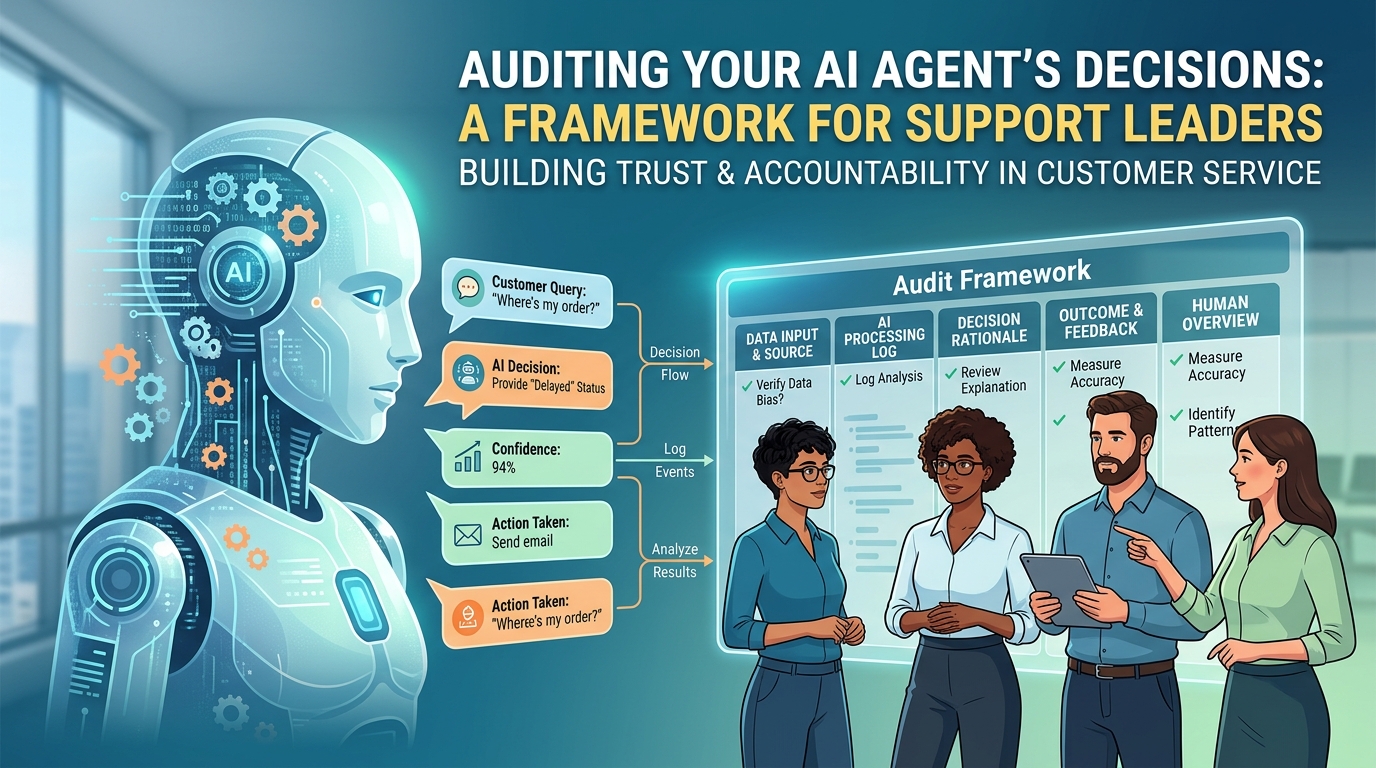
The teams with the fewest AI-related incidents aren’t the ones with the most cautious agents — they’re the ones with the most disciplined review habits. A standing audit cadence, not a one-time launch review, is what actually catches drift before it becomes a pattern of complaints.
Sample Deliberately, Not Randomly
A pure random sample of resolved conversations will mostly show you what’s already working. Weight your sample toward the conversations that carry the most risk:
- Any conversation involving a refund or credit above a set amount
- Any conversation the agent marked low-confidence but resolved anyway
- Any conversation with a sentiment drop mid-thread
- Any conversation that triggered — or nearly triggered — an escalation matrix rule
These categories surface far more real issues per hour of review than a random sample of the same size, because they concentrate exactly the situations where an agent is most likely to have made a borderline call. It’s worth building this weighted sampling into your tooling rather than relying on a reviewer to manually seek out these categories each time.
Score Against Outcomes, Not Just Tone
A common mistake is auditing for whether the agent “sounded right” rather than whether the resolution was actually correct. Pull the downstream outcome — was the refund appropriate per policy, did the customer re-contact about the same issue within a week — and score against that, not just transcript readability.
Who Should Actually Do the Reviewing
The strongest audit programs rotate reviewing duty between people with genuinely different vantage points:
- Support team lead — knows what a good resolution looks like from experience
- Policy or compliance reviewer — catches a technically-correct-sounding answer that’s actually a policy violation
- An outside reviewer — someone unfamiliar with the process, who catches things that feel normal to insiders but would seem wrong to a fresh customer
Close the Loop Into the System, Not Just a Doc
An audit finding that lives in a spreadsheet doesn’t fix anything. The audit process needs a direct path into a policy update, a prompt change, or a new escalation rule — reviewed in the same simulation sandbox before it ships, so the fix doesn’t introduce a new regression while closing the old gap. Tracking how long it takes from an audit finding to a shipped fix is itself a useful health metric for the whole program; a growing backlog of unaddressed findings is a leading indicator that the audit process has become a compliance exercise rather than an operational one.
Treat It as a Discipline, Not a Checkbox
The teams that get the most out of auditing don’t think of it as a launch-time requirement they satisfied once. They run it the way a good engineering team runs code review — as a routine, expected part of how changes get made, with its own cadence, its own weighted sampling strategy, and a rotating set of reviewers who bring genuinely different vantage points to what they’re looking at.
Budgeting Real Time for It
None of this works if auditing is treated as something reviewers fit in only when their regular workload is light. The programs that stick allocate a fixed, protected block of time each week — not “whenever there’s a gap” — specifically for weighted-sample review, and treat a skipped week the same way a skipped code review would be treated: a gap to be filled promptly, not quietly absorbed into next week’s larger backlog.