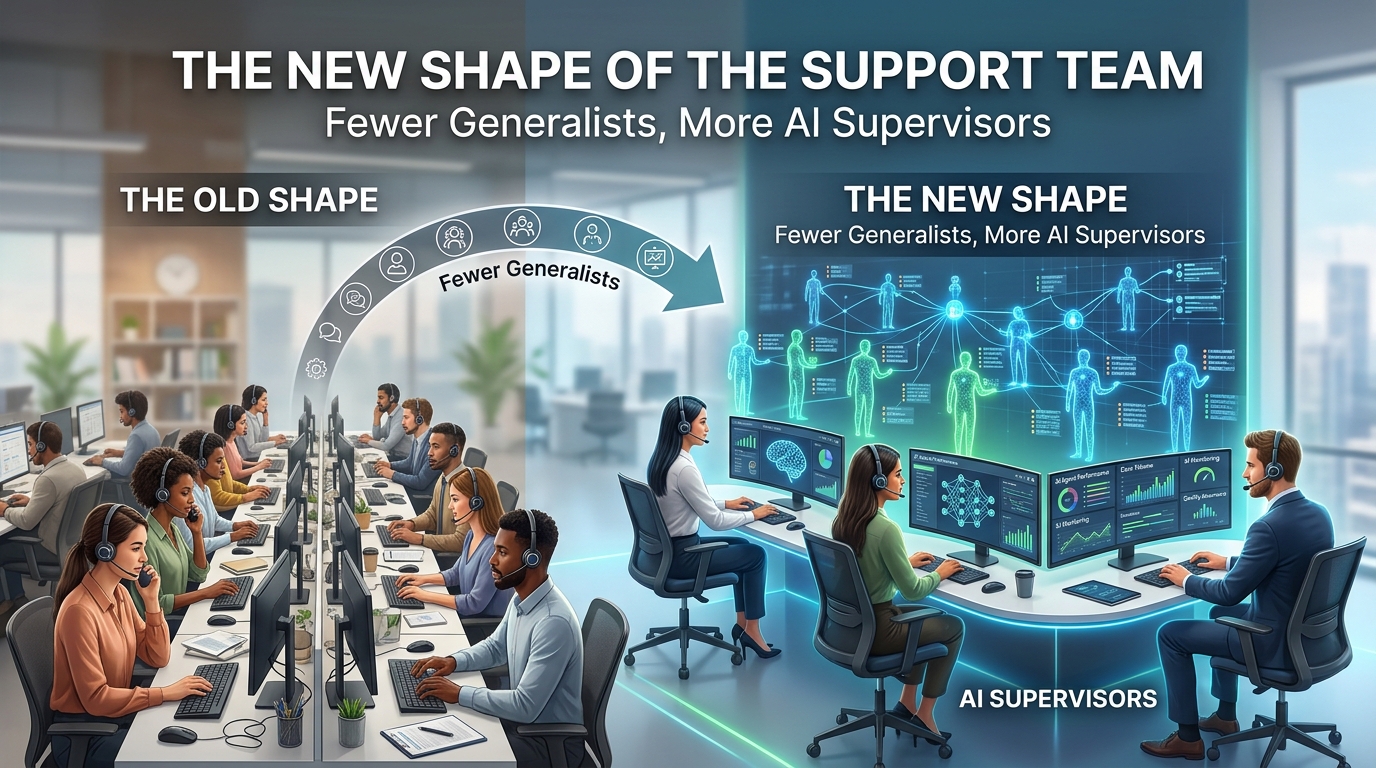
Two years into widespread AI adoption in support, the “will AI replace support agents” question has mostly resolved into something more specific and more interesting: the roles that are shrinking and the roles that are growing aren’t the same roles, and the net effect on team structure looks less like uniform downsizing and more like a genuine reshaping.
What’s Shrinking, What’s Growing
| Shrinking | Growing |
|---|---|
| Generalist Tier-1 agents | AI conversation auditors |
| High-volume, low-complexity resolution | Escalation specialists (hardest cases only) |
| Manual ticket routing | Agent trainers (curate fine-tuning data) |
Generalist Tier-1 agent roles have declined the most sharply across the accounts we work with, for the straightforward reason that this is exactly the work autonomous agents now handle well. Roles that barely existed three years ago are now standard on well-run support teams — particularly the “agent trainer” function, which curates the transcript data used to fine-tune and improve agent performance, effectively coaching the AI the way a team lead once coached a new hire.
The Skills That Transfer, and the Ones That Don’t
Agents who were strong at empathetic, patient communication with frustrated customers transition well into escalation specialist roles, where every conversation they touch is already hard. Agents whose strength was speed on repetitive tasks have a harder transition, and teams that invest in retraining toward auditing or agent-training roles see better retention than teams that simply let generalist headcount attrit. The most successful transitions involved a deliberate, structured retraining program — shadowing an existing auditor or trainer for several weeks — rather than simply reassigning a title.
Measuring the New Shape of the Team
Traditional support team metrics — tickets handled per agent, average handle time — don’t map well onto these newer roles, since an auditor’s or agent-trainer’s value shows up in the resolution-rate and quality improvements of the AI system rather than in their own direct ticket volume. Teams that keep measuring these roles against old Tier-1 metrics tend to undervalue them internally, which shows up eventually as retention problems in exactly the roles that are hardest to backfill.
A Reshaping, Not a Uniform Shrinkage
The support team of 2026 isn’t smaller in a simple sense — it’s differently shaped, with fewer people doing repetitive resolution and more doing oversight, training, and the hardest human-needed cases. Teams that plan this transition deliberately, including new metrics appropriate to the new roles, see meaningfully better retention and morale outcomes than teams that let the shift happen as an unplanned byproduct of attrition and old measurement habits carried over from a very different kind of support organization.
Hiring for Roles That Didn’t Exist When Most Teams Were Built
A practical complication several teams have run into: job postings and interview processes built for a traditional support org don’t map cleanly onto agent-trainer or AI-auditor roles, and candidates with the right mix of product knowledge and conversational judgment often don’t come from a traditional support background at all. Teams that adapted their hiring process specifically for these newer roles — rather than reusing a Tier-1 job description with a different title — report considerably better success finding and retaining people who are actually good at the work.