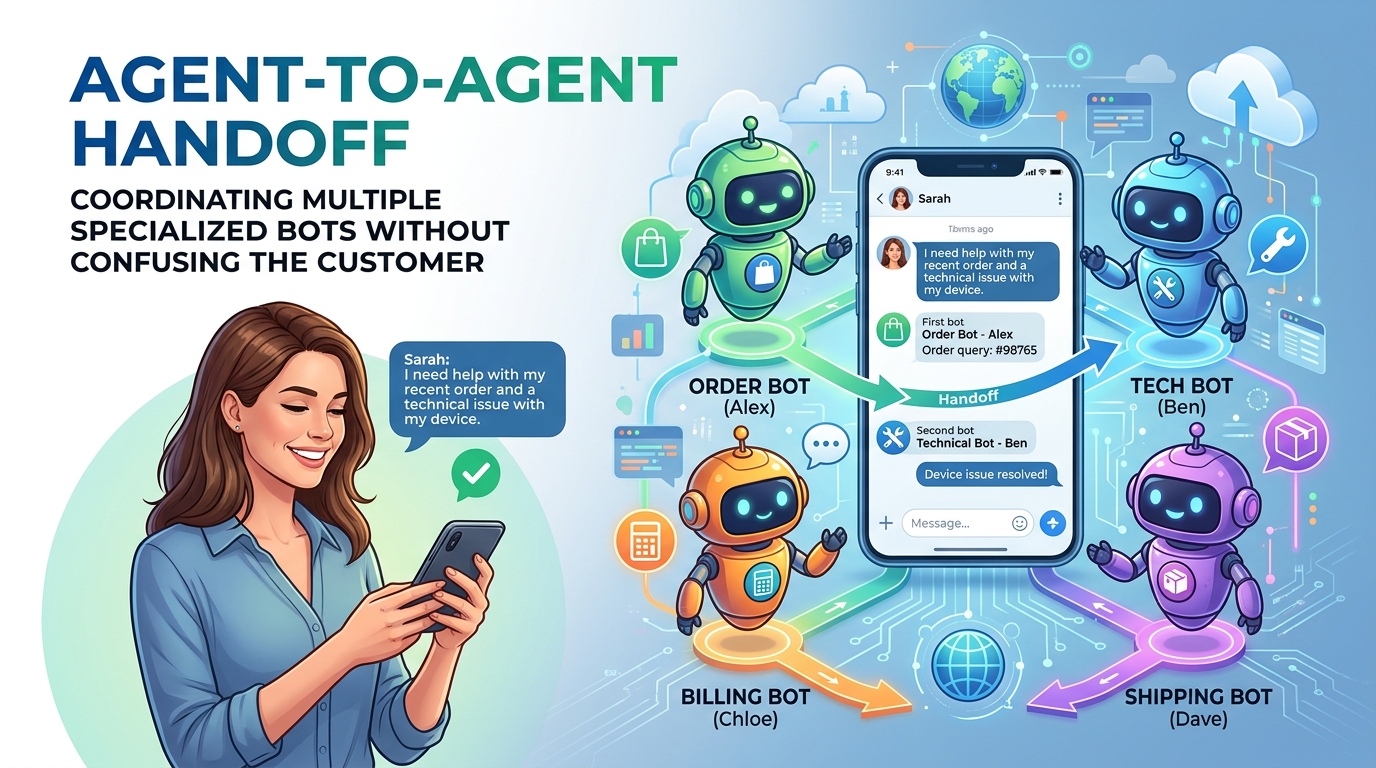
As support automation matures, a growing number of teams are moving away from a single general-purpose agent toward several specialized agents — one tuned for billing, one for technical troubleshooting, one for order logistics — each performing better within its narrow domain than a generalist could across all of them. The architectural challenge this creates is coordination: making the handoff between agents invisible to the customer, who experiences the conversation as continuous even when the underlying system doesn’t.
Why Specialization Helps, and Where It Breaks
A billing-specialized agent with deep access to payment and subscription systems resolves billing questions faster and more accurately than a generalist agent working from a policy summary. But a conversation that starts as a billing question (“why was I charged twice”) often turns into a technical one (“because a bug double-submitted my order”) mid-thread — and a poorly orchestrated handoff at that point re-introduces itself, asks the customer to repeat context, or worse, loses the thread of the original question entirely.
What a Good Handoff Looks Like
- Pass full conversational context to the receiving specialist, not just the latest message
- Pass any facts already extracted — order number, account status, sentiment
- The receiving agent acknowledges the transition briefly (“I can help with the technical side of this — I see the order in question was…”) rather than starting cold
- Never ask the customer to repeat information the previous agent already had
The Orchestration Layer Is the Real Engineering Problem
Choosing which specialist should own a given message, especially one that touches two domains at once, is a routing problem that benefits from its own evaluation separate from any individual agent’s accuracy. In practice, this means the orchestrator needs its own test suite of ambiguous, cross-domain conversations — not just a shared assumption that whichever specialist happens to be active will correctly recognize when a handoff is needed.
When to Keep a Generalist in the Loop
Not every deployment benefits from full specialization. For lower-volume support operations, the coordination overhead of multiple specialized agents can outweigh the accuracy gains each specialist provides individually, and a single well-tuned generalist agent with strong retrieval remains the more practical choice. The threshold where specialization starts paying for itself tends to track volume and domain complexity together — a high-volume, narrowly-scoped domain like billing is a much stronger candidate for its own specialist than a low-volume, broad one.
Multiple Specialists Beat One Generalist — On One Condition
Multiple specialized agents can outperform one generalist, but only if the seams between them are engineered as carefully as the specialists themselves. Teams that invest heavily in specialist quality while treating the handoff layer as plumbing consistently underperform teams that gave both roughly equal engineering attention, because the customer’s actual experience of quality is shaped disproportionately by what happens at exactly the moments a conversation crosses a domain boundary.
A Test Suite Built Specifically for the Seams
In practice, building confidence in an orchestration layer means constructing test conversations that deliberately straddle two domains — a billing complaint that turns out to be a technical bug, a logistics question that turns into a refund request — and checking not just whether the right specialist eventually handles it, but whether the transition itself felt seamless from the customer’s side. A specialist-only test suite, however thorough, will never surface this class of failure, because by construction it never asks a single specialist to handle a conversation that should have been handed off.