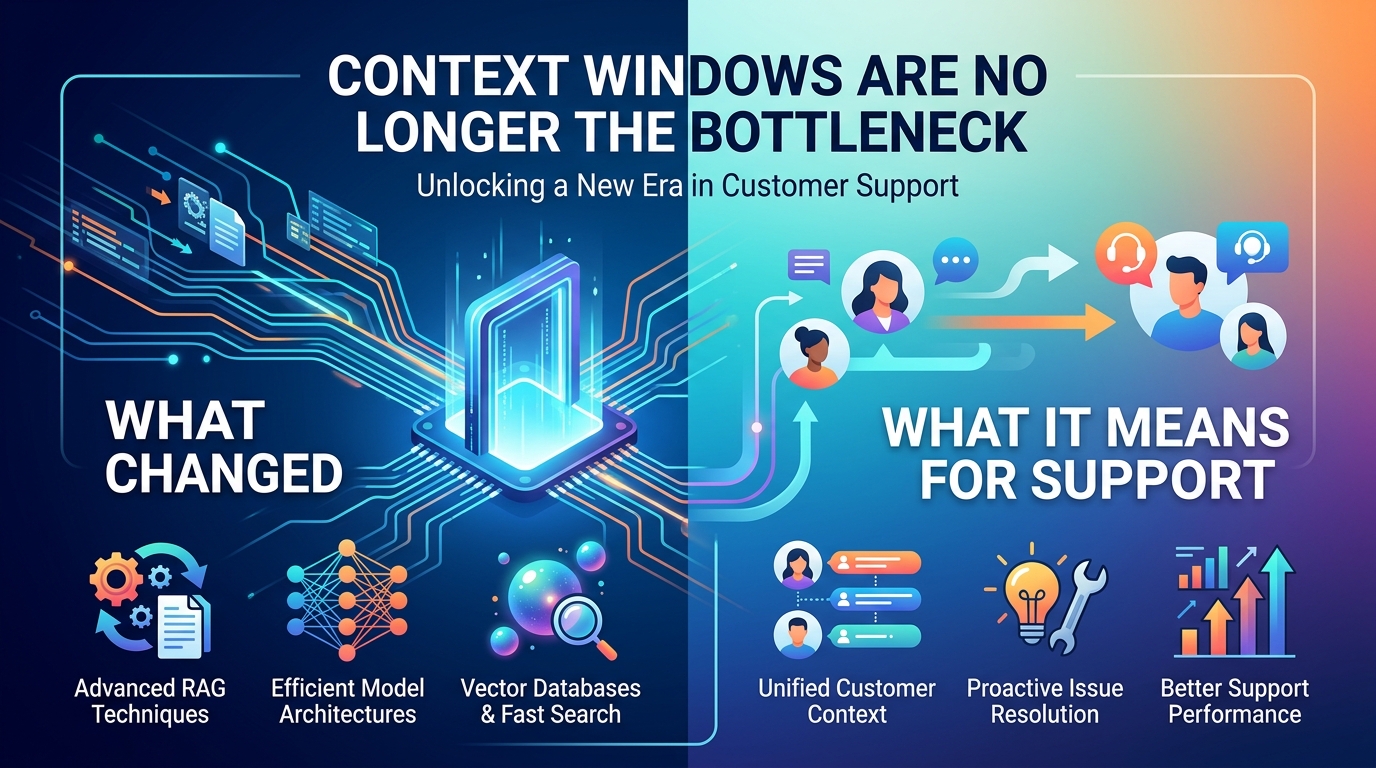
Two years ago, context window size was the headline spec in every model release, and support teams built entire architectures — chunking, retrieval, aggressive summarization — around the constraint of not being able to fit a customer’s full history into a single prompt. That constraint has largely dissolved. The harder problem it was masking has not.
The New Bottleneck Is Relevance, Not Capacity
With enough context capacity to hold a customer’s full conversation history, purchase record, and product usage data simultaneously, the failure mode shifts from “the model doesn’t know this” to “the model knows this but didn’t weight it correctly.” A model holding 50,000 tokens of mostly irrelevant history can perform worse than one given a tightly curated 2,000 tokens, because relevant signal gets diluted rather than surfaced.
Retrieval Didn’t Go Away — It Changed Jobs
| Old job (2023-2024) | New job (2026) | |
|---|---|---|
| Constraint | Limited context capacity | Limited attention within ample capacity |
| Retrieval’s role | Fit relevant data within a token budget | Rank and select what to prioritize, even with room to spare |
| Failure mode | “The model never saw this” | “The model saw it but didn’t weight it correctly” |
Measuring Relevance Is Its Own Hard Problem
Once “what to surface” replaces “what fits” as the design question, teams need a way to actually measure whether their curation is working — which is harder than it sounds, because a curation system can look reasonable in isolated review and still systematically underweight a category of information that turns out to matter more than expected. Building an evaluation set specifically for context curation quality, separate from evaluating the model’s final answer quality, is an emerging best practice that’s still underused across the industry.
What This Means for Your Memory Architecture
If your agent memory system was built primarily to solve “how do we fit everything,” it’s worth revisiting with a new question: “of everything we could show the model, what’s actually predictive of a good answer to this specific message.” That’s a ranking and curation problem, not a storage problem, and it needs its own evaluation separate from raw context capacity. Teams that treat this as a one-time re-architecture rather than an ongoing tuning exercise tend to see an initial improvement that plateaus, because the relevance model itself needs the same kind of iteration and monitoring as any other part of the agent.
Bigger context windows removed a real constraint, but they didn’t remove the need for judgment about what to show a model — and that judgment, not raw capacity, is where the competitive gap is now. It deserves the same deliberate measurement and iteration that teams have historically reserved for model choice itself, rather than being treated as a solved problem once the context window stopped being the limiting factor.
A Genuinely Counterintuitive Result
This is a genuinely counterintuitive result for teams that spent the last two years treating “more context” as an unambiguous improvement, and it requires a real shift in how architecture decisions get made. The instinct to reach for a bigger context window whenever an agent seems to be missing something is understandable given how real that constraint used to be — but in 2026, the more productive instinct is usually to ask what’s crowding out the signal that matters, not how much more room the model needs.