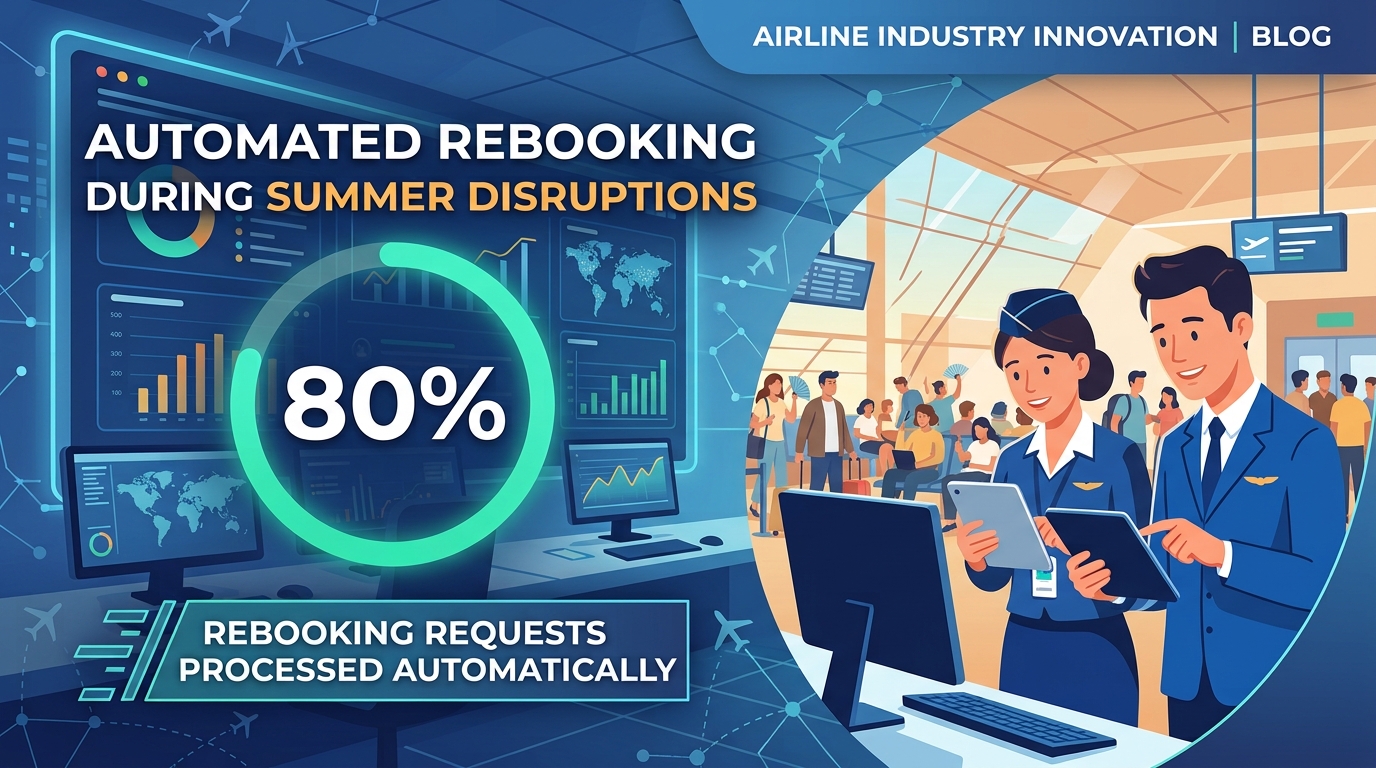
Weather-driven flight disruptions are the single hardest stress test for any airline’s support operation: thousands of affected passengers within hours, all needing the same fundamental thing — a new flight — while every other passenger books through the same limited inventory in real time. When a summer storm system cancelled hundreds of flights in a single week, SkyBridge Airlines’ rebuilt rebooking flow kept the queue from collapsing.
The Problem: An Approach That Didn’t Scale
Before this deployment, rebooking during a major disruption meant a phone queue that could stretch past two hours, and a chat queue nearly as long, because every rebooking required a human agent to manually search availability, apply fare rules, and confirm the change — a process that took 8-12 minutes per passenger even for a straightforward same-day alternative. During SkyBridge’s worst disruption events in prior years, queue times had climbed high enough that a meaningful share of affected passengers gave up on contacting support altogether and went to the airport gate directly.
What the AI-First Flow Does Differently
SkyBridge’s new flow gives the agent direct, real-time access to seat inventory and fare rule logic, letting it search and present two or three viable rebooking options within seconds of a passenger describing their disrupted flight — then execute the change directly for standard cases, with a mandatory human review only for cases involving connecting international itineraries or special fare classes. Passengers interact through whichever channel they already use — the airline’s app, SMS, or WhatsApp — rather than needing to navigate to a specific disruption-handling page.
Handling the Cases That Still Need a Human
International connections, group bookings, and any itinerary touching a codeshare partner were routed directly to specialized human agents rather than attempted by the agent and escalated after a failed attempt — a deliberate design choice made during the escalation matrix design phase, well before the disruption week.
Results During the Disruption Week
| Metric | Before this deployment | During disruption week |
|---|---|---|
| Rebooking time, domestic single-segment | 11 min (human) | 47 sec (AI) |
| Rebooking requests resolved without human involvement | N/A | 80% |
| Complex-itinerary queue wait time at peak | 2+ hours (prior events) | Under 15 min |
| Gate-side crowding vs. comparable prior disruptions | Baseline | Meaningfully lower |
The gain here wasn’t a smarter model; it was giving the agent the same real-time systems access a human agent uses, and being disciplined about routing only the cases it could actually handle well to automation in the first place.
Upfront Routing Mattered as Much as the Automation Itself
This upfront routing decision, made during the escalation matrix design phase well before the disruption week, turned out to matter as much as the automation itself: passengers with complex itineraries were told immediately they’d be speaking with a specialist, rather than spending several minutes with the automated flow before being redirected. SkyBridge’s operations team credited that early, honest routing with a meaningful share of the queue-time improvement for complex cases — not because those passengers were handled any faster once they reached a specialist, but because they weren’t wasting minutes on an automated attempt that was never going to succeed for their specific itinerary.