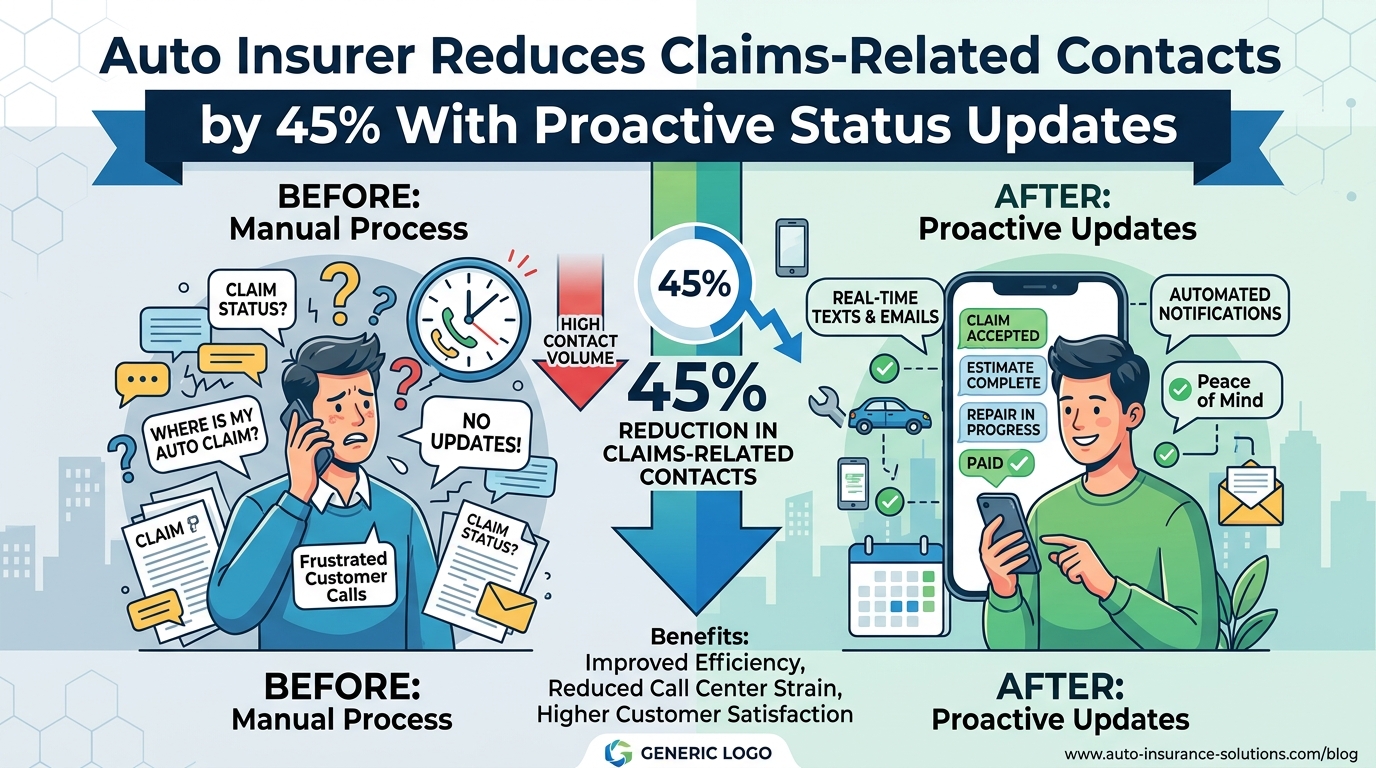
Meridian Auto Insurance found that the single largest category of inbound contact wasn’t a complex claims dispute — it was customers asking “what’s the status of my claim,” a question Meridian’s own systems already had a current answer to at the moment the customer asked it.
The Pattern Behind the Volume
Claims processing involves several discrete stages — filed, under review, adjuster assigned, estimate received, payment approved — and customers, understandably anxious about a claim tied to a damaged vehicle, would contact support at nearly every stage transition just to confirm progress, often multiple times per claim. Internal analysis showed the average claim generated 4.2 status-check contacts before resolution.
Proactive Status Updates, Not Just Self-Service Lookup
Rather than simply making claim status available via self-service lookup — which still requires the customer to think to check — Meridian moved to proactive, automated notifications at each stage transition, sent through the customer’s preferred channel, with a clear next expected step and timeframe rather than just a status label. A notification reading “your estimate has been received and is now with an adjuster for approval, expected within 2 business days” gives meaningfully more reassurance than a bare status change to “under review.”
Anticipating the Follow-Up Question, Not Just the Status
Meridian found that a bare status update alone still generated some follow-up contact volume — usually a customer asking what happens next or how long the next stage typically takes. Adding that expected-next-step information directly into the proactive notification closed most of this remaining gap.
Results
| Metric | Before | After |
|---|---|---|
| Status-check contacts per claim | 4.2 | -45% |
| Human specialist time per remaining contact | Baseline | Higher (more complex cases only) |
| Customer satisfaction on claims | Baseline | Up, driven by “always knew what was happening” |
| Actual claims processing speed | Baseline | Unchanged |
A large share of “support volume” is really unmet information demand. Proactive, well-timed updates that anticipate the customer’s next question often reduce contact volume more effectively than making the same information easier to look up.
What Meridian’s Specialists Noticed
Specialists reported being able to spend meaningfully more time per complex case than before, since their overall contact volume had dropped even as the complexity of an average remaining contact rose. Meridian’s own analysis attributed the satisfaction gain almost entirely to the proactive communication itself rather than any change to actual claims processing speed — a distinction worth keeping in mind for any team assuming “faster processing” is the only lever available for improving claims satisfaction.