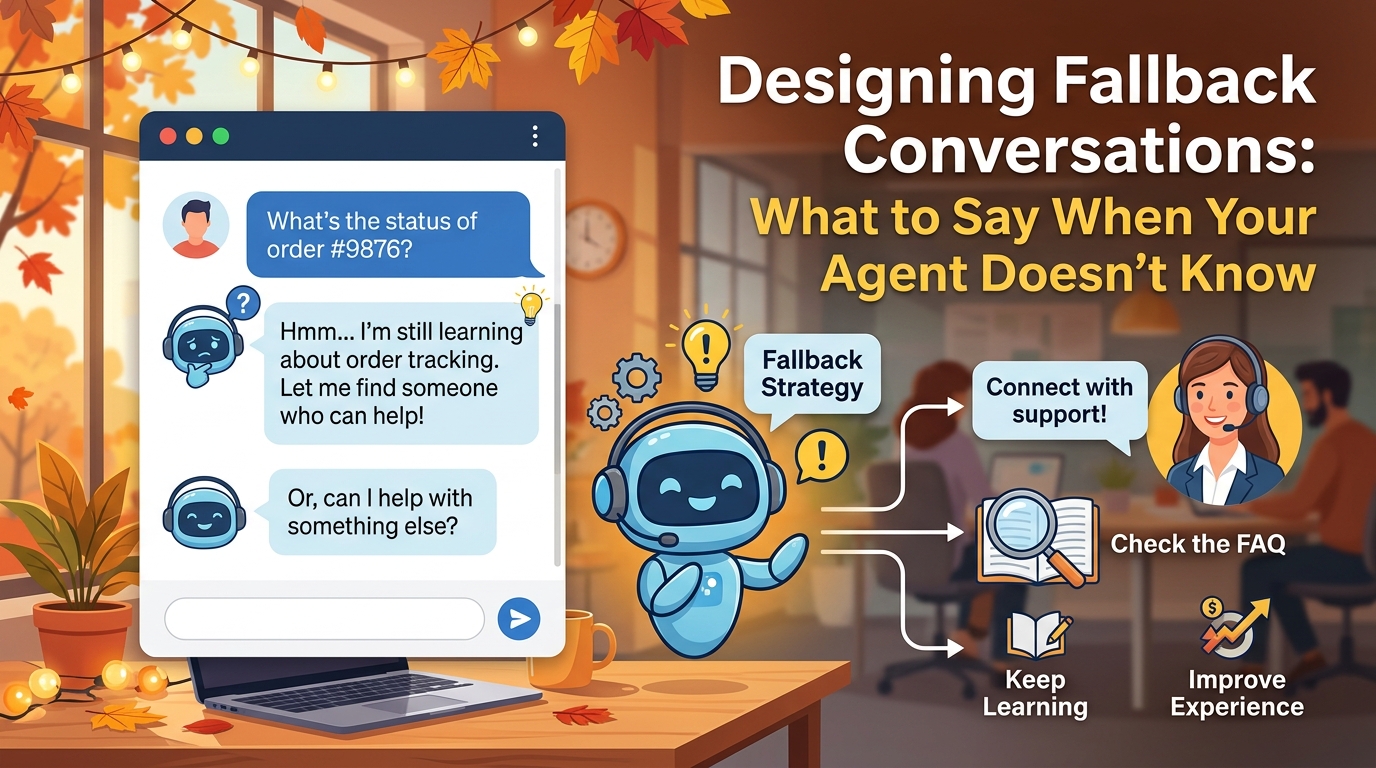
Every support bot eventually hits a question it can’t answer. What happens next — a dead-end “I don’t understand,” a graceful handoff, or a useful partial answer — determines whether that moment feels like a minor speed bump or a reason to distrust the whole system.
The Three Failure Modes to Avoid
The worst fallback is a repeated, identical “I’m sorry, I didn’t understand that” that gives the customer no new information about what to try next. The second worst is an overconfident guess dressed up as an answer. The third is a fallback that routes to a human but loses all context from the conversation so far, forcing the customer to repeat themselves.
A Fallback Taxonomy, Not a Single Message
Different failure reasons deserve different fallback text:
| Failure type | Bad fallback | Good fallback |
|---|---|---|
| No matching order record | “I’m not sure I understand” | “I couldn’t find an order under that email — could you share your order number instead?” |
| Intent not classified | “Sorry, please try again” | “I’m not sure what you’re asking about — is this about an order, a return, or something else?” |
| Out of supported scope | Attempts a guess | “That’s outside what I can help with directly — let me connect you with someone who can.” |
Escalating With Context Intact
When a fallback leads to a human handoff, the single highest-leverage engineering investment is passing the full conversation transcript and any extracted entities (order number, product, sentiment) to the receiving agent automatically. A customer who has to re-explain their problem after being told “let me get someone who can help” experiences that as the system failing twice, not once. This is worth testing specifically and repeatedly, since context-passing is exactly the kind of integration point that quietly breaks when an unrelated system changes.
Learning From Fallback Frequency, Not Just Fallback Quality
Beyond writing better fallback messages, tracking which intents trigger fallback most often is one of the most direct signals for where to invest in expanding the bot’s actual coverage next. A spike in fallbacks for a particular topic after a product launch is a clear, early signal that the knowledge base or training data hasn’t caught up with a recent change — often visible in this data well before it shows up as a broader satisfaction problem.
Testing Fallbacks the Same Way You Test the Happy Path
Fallback conversations are easy to skip in QA, precisely because they’re not the flow anyone is proud to demo. That’s exactly why they need deliberate test coverage — a scenario suite that intentionally sends the bot ambiguous, unsupported, and malformed requests, checked against the taxonomy above, catches regressions in fallback quality the same way an eval suite catches regressions in the happy path. Teams that treat fallback testing as optional tend to discover their fallback quality has quietly degraded only after a spike in complaints, well after a routine test pass would have caught it for free.
The Tone of a Fallback Matters More Than It Seems
Beyond content, the tone of a fallback message carries disproportionate weight, because it’s often the moment a customer is already at least mildly frustrated — the bot has just failed to understand them. A fallback that reads as apologetic without being useful (“I’m so sorry, I really am having trouble with this”) compounds the frustration by dwelling on the failure; a fallback that’s brief, matter-of-fact, and immediately moves toward a concrete next step reads as competent rather than apologetic, even though it’s delivering essentially the same underlying message that the bot couldn’t handle the request alone.