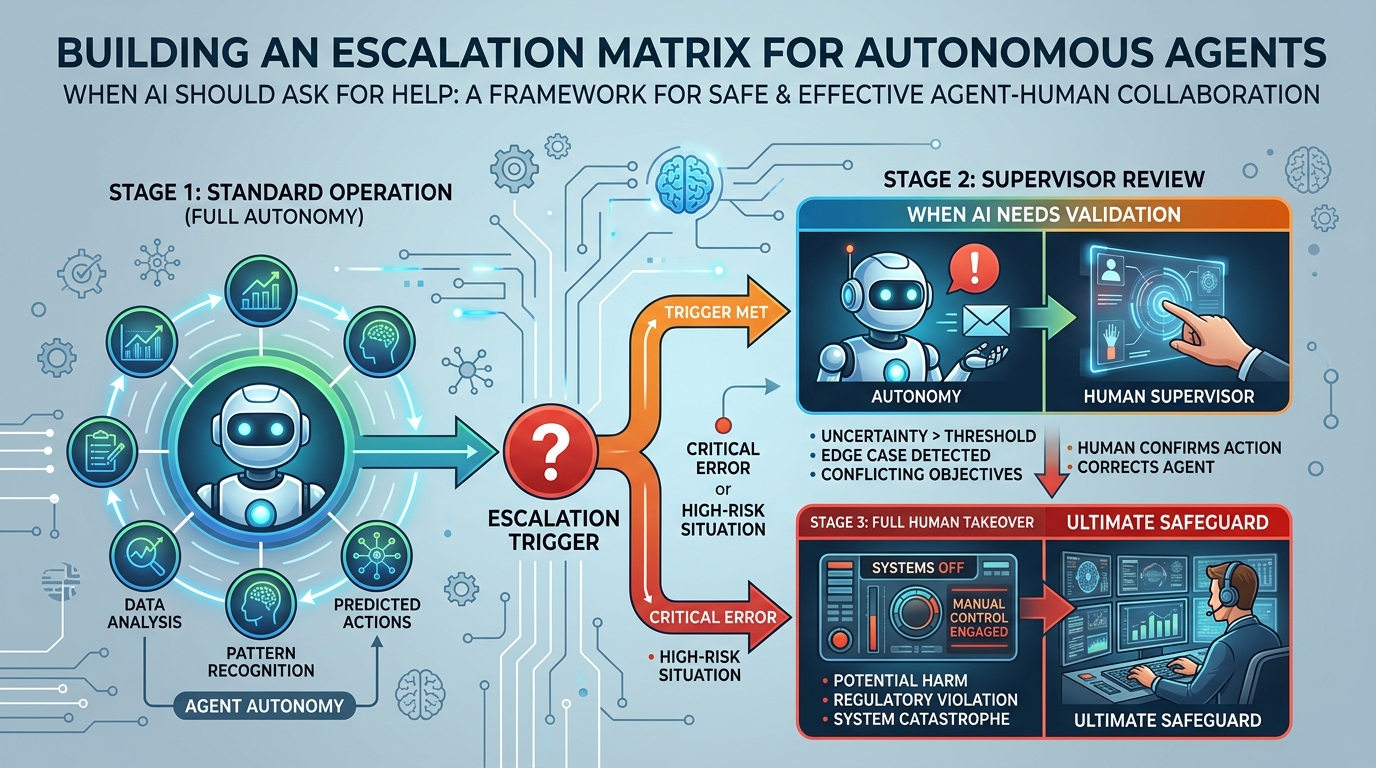
Most teams that deploy an autonomous support agent do it backwards: they launch, wait for something to go wrong, and patch the escalation logic after the fact. By then, the damage — a wrong refund, a customer who was told to wait 48 hours for something urgent — is already done. An escalation matrix, built before launch, flips that order.
Step 1: Pull Your Historical Ticket Data
Before writing a single rule, pull six months of resolved tickets and bucket them by resolution difficulty and dollar value. In nearly every dataset we’ve reviewed, a small number of intent categories account for a disproportionate share of complaints and chargebacks — refunds above a certain amount, anything touching legal or medical claims, and multi-party disputes. Start your matrix with hard boundaries around those categories, and only widen agent autonomy into a category once you have enough resolved-transcript data to audit its accuracy.
Step 2: Draft the Matrix as a Table, Not a Policy Doc
Each row names a trigger condition and maps it to an action. Vague categories like “complex issues” don’t work as triggers because your agent cannot self-assess complexity reliably; only concrete, measurable signals can gate a decision.
| Trigger | Condition | Action |
|---|---|---|
| Refund amount | Under $50 | Auto-resolve |
| Refund amount | $50–$500 | Resolve, log for audit |
| Refund amount | Over $500 | Escalate to senior agent |
| Regulated topic | Legal, medical, or financial-advice language detected | Escalate immediately, no auto-resolve |
| Sentiment | Score drops 2+ points within the conversation | Escalate to senior queue |
| Repeat contact | 3rd contact on the same issue in 7 days | Escalate + flag for CSM review |
Step 3: Separate Hard Limits From Soft Limits
Hard limits never move regardless of how well the agent performs — anything touching a regulated claim, for instance. Soft limits are deliberately provisional, meant to loosen as confidence in the agent’s track record in that category grows. Mixing the two into one undifferentiated list makes the matrix harder to review later, because nobody can tell at a glance which rows are safety rails and which are just current caution.
Step 4: Draft It With the Three Stakeholders Who’ll Live With It
The matrix works best when it’s drafted jointly by whoever owns policy (often legal or compliance), whoever owns the customer relationship (support leadership), and whoever owns the model (the AI or engineering team). A matrix written by engineering alone tends to under-escalate anything that isn’t a technical edge case; one written by compliance alone tends to over-escalate to the point that the agent adds little value.
Step 5: Review Monthly Against Near-Misses
Every escalation your agent gets right without help is a candidate for loosening a threshold; every incident is a candidate for tightening one. Review the matrix monthly against a sample of borderline cases — conversations that almost triggered a handoff — rather than only the ones that did, since those near-misses tell you where the boundary is actually drawn. A row that hasn’t been touched in six months isn’t necessarily well-tuned; it might just be a rule nobody has looked at since launch.
It also helps to record, per row, the confidence level the agent must have before acting, and what happens on a tie — should the system default to escalating when it’s genuinely unsure, or is a lower-stakes intent safe to resolve even at moderate confidence. Writing this down explicitly avoids the common failure where a confidence threshold is buried in a prompt nobody has looked at in months, and it gives whoever reviews the matrix each month a concrete number to argue about instead of a vague feeling that “the bot seems fine.”
Who Owns the Matrix Once It Ships
A matrix with no named owner tends to drift the fastest, because a threshold change requires someone to notice a pattern, propose an edit, and get it reviewed — work that happens reliably only when it’s someone’s actual job. Teams that assign a single owner (usually whoever also owns the escalation queue’s staffing) see far more consistent monthly reviews than teams that treat the matrix as a shared, ownerless document. That owner doesn’t need to approve every change alone — the joint drafting process described in Step 4 still applies to any change with real policy weight — but they’re the one who makes sure the review actually happens on schedule rather than sliding by a quarter every time something more urgent comes up.