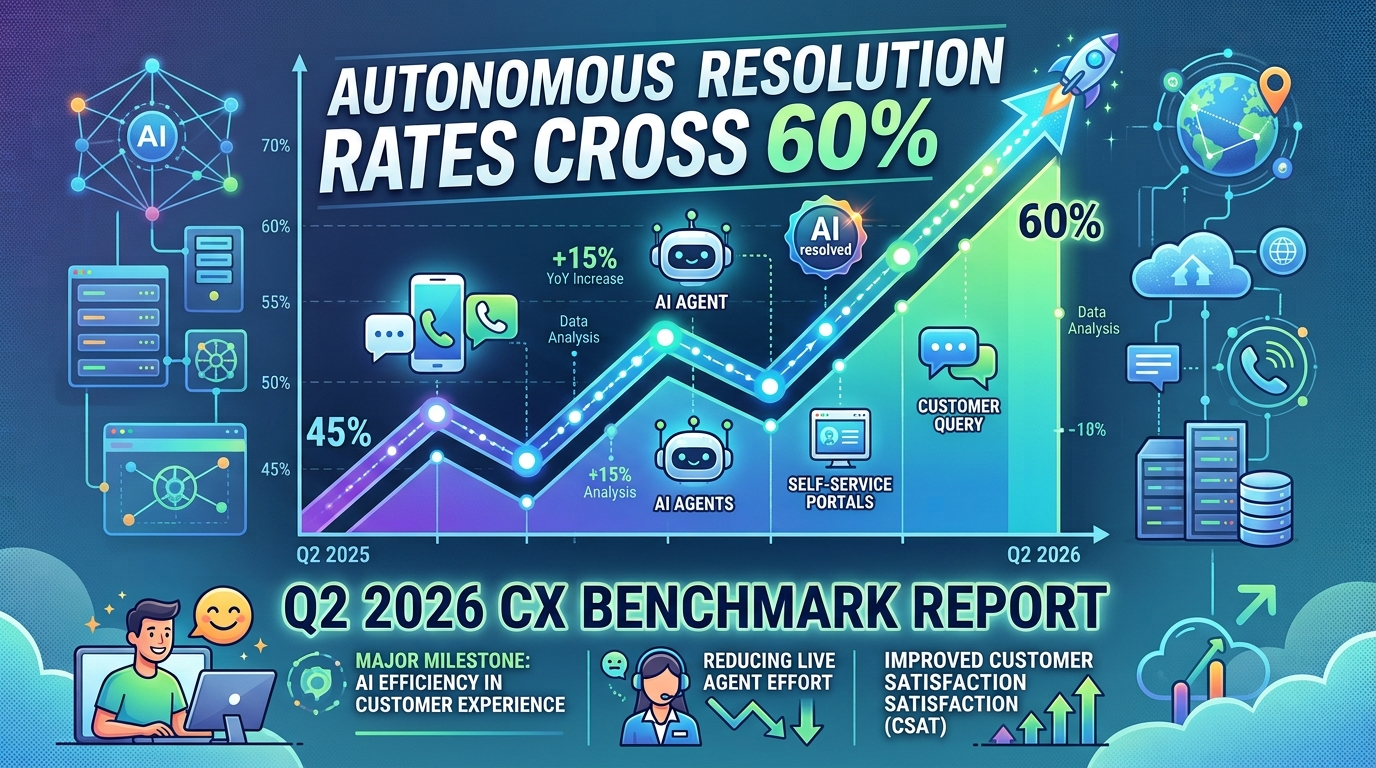
Following our Q1 2026 report, this quarter’s data — aggregated and anonymized across customer accounts — shows the industry-wide autonomous resolution rate crossing 60% for the first time, up from 54% at the end of Q1. The headline number, though, masks a wide and informative spread by industry and use case.
Autonomous Resolution by Industry, Q2 2026
| Industry | Average autonomous resolution | Change vs. Q1 |
|---|---|---|
| Ecommerce | 74% | +5 pts |
| Travel | 68% | +4 pts |
| SaaS / Tech | 63% | +6 pts |
| Insurance | 49% | +2 pts |
| Fintech / Banking | 43% | +1 pt |
| Overall average | 60% | +6 pts |
Fintech and insurance accounts, weighed down by compliance-driven escalation requirements, are hitting a structural ceiling that general-purpose model improvements haven’t moved much — a deliberate design choice, since the escalation matrices in these industries are correctly more conservative.
What’s Driving the Q1-to-Q2 Gain
The single largest contributor to the quarter-over-quarter improvement was not a new model generation but broader adoption of agent memory — accounts that added persistent cross-conversation memory during Q2 saw autonomous resolution rise an average of 6 points within eight weeks, roughly double the gain from a comparable model upgrade alone.
The Bottom Quartile Tells Its Own Story
Accounts in the bottom quartile weren’t concentrated in any single industry — they were spread across every vertical, and the common thread was operational rather than structural: infrequent configuration review, no dedicated ownership of the escalation matrix, and in several cases no measurement of autonomous resolution rate at all until this benchmark prompted them to start tracking it.
CSAT Held Steady, Not Lagged
A frequent worry raised about rising autonomous resolution is that it comes at the cost of satisfaction. Aggregate CSAT across the same account base was flat quarter-over-quarter, and rose slightly among accounts specifically in the top quartile for autonomous resolution — reinforcing that resolution rate and satisfaction aren’t in tension when escalation logic is well-tuned. The accounts where CSAT did decline alongside rising automation were, without exception, accounts that had widened agent autonomy without a corresponding increase in audit or review activity — a pattern worth watching closely if your own account is expanding autonomy quickly this quarter.
Reading Your Own Number Against This Report
60% autonomous resolution is a real milestone, but the more useful exercise for any individual team is finding your industry row in the table above and comparing against that, not the global average — a fintech account sitting at 50% autonomous resolution is outperforming its cohort, while an ecommerce account at the same number is underperforming badly. Know your ceiling before you set your target, and treat operational discipline, not model choice, as the more likely lever if your own numbers are lagging the benchmark for your vertical.
A Note on Methodology
As with our Q1 report, “autonomous resolution” here is defined strictly as a conversation the customer confirmed as resolved without any human involvement — not merely a conversation that didn’t escalate. We deliberately exclude deflection-without-resolution from this figure, since a high resolution rate achieved by ending conversations rather than solving problems is a liability that tends to show up in churn and re-contact data well after it stops looking like a problem on a support dashboard.