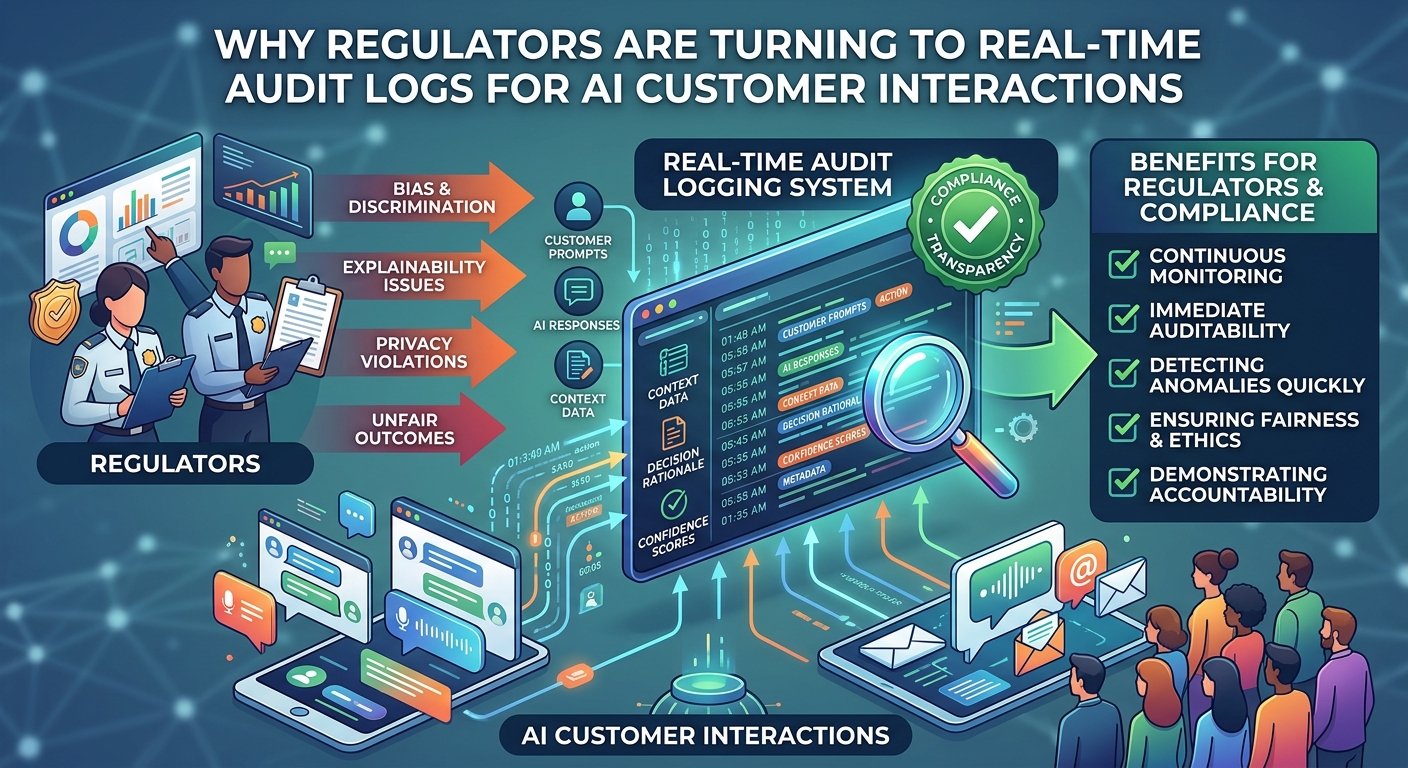
The regulatory conversation around AI in customer-facing roles has shifted noticeably over the past year, from a focus on whether disclosure happened at all to a much more specific expectation: that companies can produce, on demand and often in near-real-time, a record of exactly what an AI system decided in a given customer interaction and why.
From Periodic Review to Continuous Record
Early AI governance guidance across several jurisdictions treated periodic internal audits as sufficient evidence of oversight. More recent guidance and early enforcement actions have moved toward expecting continuous, structured logging — not because periodic review is inherently insufficient, but because regulators investigating a specific complaint increasingly expect to see the actual decision record for that exact interaction, not a summary drawn from a later sample audit.
What “Sufficient” Logging Looks Like in Practice
- The input that triggered a decision
- The policy or rule version in effect at that moment
- A summary of the reasoning path
- The final action taken
A record that includes the final decision alone, without the policy version in effect at the time, has proven insufficient in several enforcement cases we’ve reviewed, since it leaves open the question of whether the decision was correct under the rules that applied at that moment versus rules later changed.
The Direction of Travel
Several regulators have signaled interest in mandating this kind of logging specifically for AI systems making financially consequential decisions — refunds, credit adjustments, claims determinations — even in jurisdictions without a broad AI-specific regulatory framework yet. Companies building this capability now, ahead of a mandate, avoid a rushed retrofit later.
Practical Steps for Teams Not Yet There
For teams that haven’t yet built comprehensive decision logging, the practical starting point isn’t necessarily a full regulatory-grade system — it’s ensuring that every consequential automated decision at minimum records what happened and under what policy, even if the format isn’t yet standardized to any particular regulator’s expected structure. That basic discipline, adopted early, is far easier to retrofit into a compliant export format later than reconstructing a missing record after the fact ever will be.
The Voluntary Adopters Are Already Seeing a Side Benefit
Several of the enterprise accounts we work with that adopted comprehensive logging voluntarily, well before any specific requirement applied to them, have reported that the resulting internal visibility improved their own operational decision-making independent of any regulatory benefit — surfacing exactly the kind of cross-team policy drift that’s otherwise invisible without a common, structured record to compare against.
This Mirrors a Pattern From Other Regulated Sectors
This shift mirrors a broader pattern in financial and healthcare regulation, where periodic reporting has gradually given way to continuous, queryable record-keeping as the expected standard once the underlying technology to support it became practical and affordable. Companies that treated early continuous-logging requirements in those sectors as a compliance burden to minimize, rather than an operational capability worth building well, generally paid more over time — both in retrofit costs and in slower responses to the regulatory inquiries that inevitably followed.