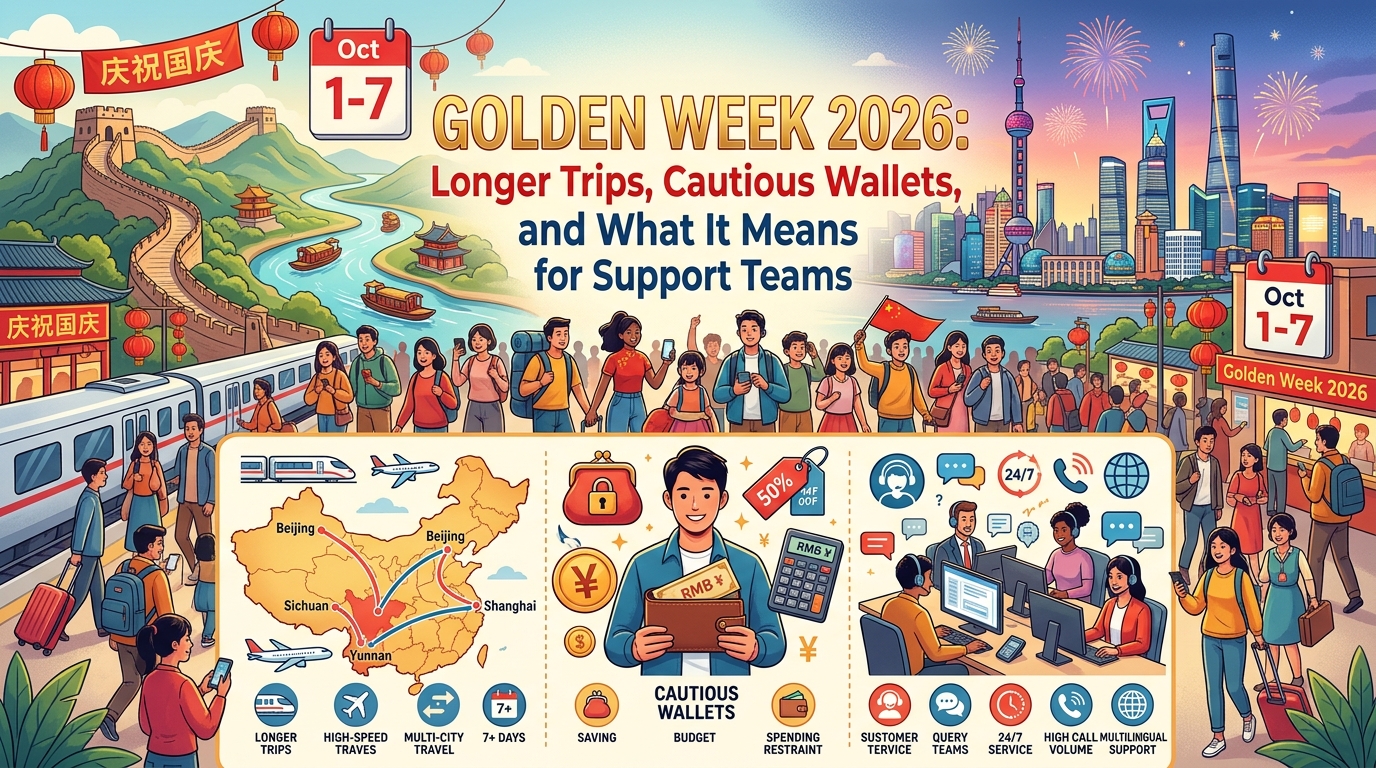
China’s National Day Golden Week began on October 1, and the early data points in two directions at once. People are travelling farther and for longer than in previous years, yet they are watching every yuan. For support teams at airlines, hotels, travel platforms and the retailers that sell to travellers, that combination produces a very particular kind of peak.
What the Numbers Say So Far
Reporting from Reuters ahead of the holiday, republished by The Star on September 29, pulled together the clearest picture of this year’s trip patterns:
| Signal | What was reported | Source cited by Reuters |
|---|---|---|
| Length of break | Many travellers combined Golden Week with the Mid-Autumn Festival on September 25 for a 13-day break | Reuters reporting |
| Long stays | Hotel stays of at least seven nights up 123% year on year | Trip.com Group |
| Complex itineraries | Multi-destination itineraries up 84% | Trip.com Group |
| Early departures | More than half of outbound flight bookings departed before October 1, with average trips longer than nine days | Trip.com Group |
| Overseas intent | 54% of survey respondents planned an overseas trip over the holiday, up from 35% a year earlier | Dragon Trail International |
| Spending | Average spending per trip during last year’s Golden Week was 911.04 yuan, a three-year low | Reuters calculation from government data |
The government is also pushing demand: a month-long National Day Cultural and Tourism Consumption Month started on September 22, alongside a 16-day peak rail period.
Longer, Multi-Leg Trips Change the Contact Mix
A three-night city break generates a booking question and perhaps a check-in question. A nine-day, multi-destination trip that started before the holiday officially began generates something different: questions in the middle of the trip, often about connections between suppliers, from a customer in a different time zone who needs an answer now.
Expect a larger share of contacts to be:
- Changes in motion: a delayed first leg putting the second hotel or a rail connection at risk.
- Cross-supplier questions: “my flight moved, what happens to the transfer I booked separately?”
- Out-of-hours by default: a customer in Lisbon or Auckland is awake when your home-market team is not.
This is exactly where an AI agent with access to the full itinerary earns its keep. It can see every leg, explain the knock-on effect of one change and resolve the simple cases at 3 a.m. local time. The complex ones should reach a human with the whole itinerary and conversation attached, so the customer never has to start again.
Cost-Sensitive Travellers Ask Different Questions
The same Reuters report quotes Dragon Trail’s Sienna Parulis-Cook describing a market that is “more cost-sensitive than previously”. Mid-range hotels were the most popular choice in Dragon Trail’s survey, at 33%, against 5% planning luxury stays.
Cost-sensitive customers read the small print, so support sees more questions about:
- Cancellation and change fees, especially on non-refundable fares bought early.
- What is included: breakfast, baggage, transfers, taxes.
- Price changes: “the same room is cheaper today, can I get the difference?”
These are policy questions, and policy answers have to be exact. Make sure the rules your AI agent quotes are the ones that apply to this booking and this market, not a generic summary.
What to Do This Week
If you’re in travel
Watch for disruption clusters. A weather event or an airline schedule change can generate thousands of near-identical contacts within an hour. Proactive messages to affected travellers, sent before they reach out, are the cheapest contacts you will ever handle.
If you’re in retail or e-commerce
Customers who are travelling still shop, and still ask where their order is. Delivery estimates should account for the holiday and courier schedules. The holiday also runs straight into the Singles’ Day presale season, so the next peak is only days away.
If you serve outbound travellers
Check language coverage and hours. A customer abroad may message in Chinese from a European time zone, and your routing should not assume they are in mainland China during business hours.
The Takeaway
More travellers do not automatically mean more revenue. As Liao put it to Reuters, “More travellers do not necessarily mean proportionately higher profits.” They do reliably mean more support contacts, and more complicated ones. The teams that do well this week will be the ones that answer mid-trip questions in context, quote policies accurately and save their human experts for the cases that genuinely need them.