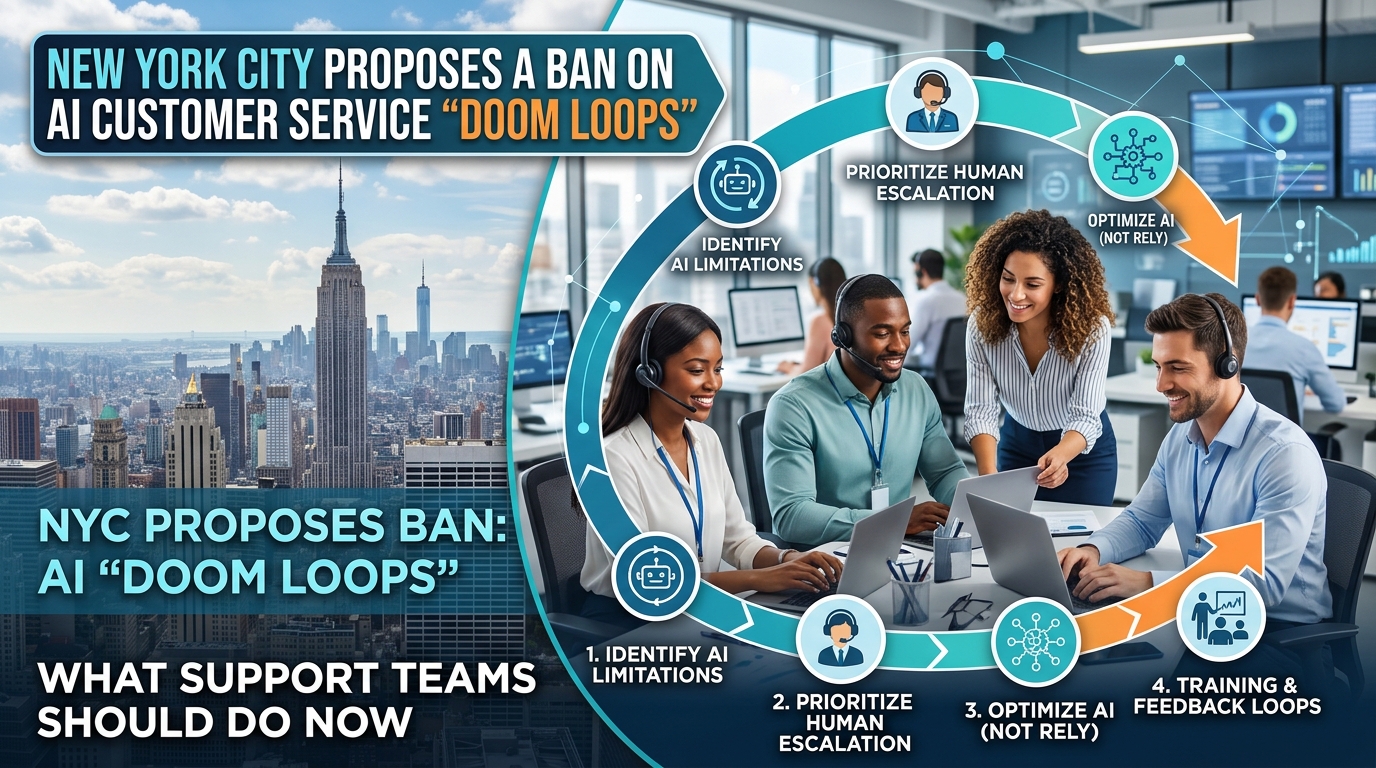
On October 20, New York City’s consumer protection agency proposed rules aimed at what it calls AI customer service “doom loops”: the experience of being trapped in an automated system that never resolves your problem and never lets you reach a person. The rules are only proposed, and they apply to businesses dealing with New Yorkers, but they put into writing what many customers already expect. Support teams everywhere should read them as a preview of where the standard is heading.
What the City Proposed
According to the announcement from the Department of Consumer and Worker Protection (DCWP), the proposed rule would:
| Proposed requirement | In the city’s words |
|---|---|
| Disclosure | “Require businesses to disclose when a customer is talking to an automated customer service system such as AI” |
| A route to a person | “Require businesses to provide an easy offramp to speak to a human representative” |
| Accountability | “Prohibit businesses from evading responsibility for using AI that results in unlawful conduct” |
| Real help | “Require businesses to actually offer meaningful customer assistance if it is advertised” |
| Doom loops as a trade practice | Treat it as a deceptive and unconscionable trade practice to imply service is available and then repeatedly and unreasonably fail to address inquiries, or to respond only with unresponsive, irrelevant or erroneous information |
The city says violators would be liable for restitution to harmed consumers and civil penalties, with fines starting at $525, and that DCWP would gain citywide enforcement authority. There is a 30-day comment period that includes a public hearing.
What Officials Said
Mayor Zohran Mamdani framed the rule around cost-cutting: “customer service cost-cutting can’t come at New Yorkers’ expense.” DCWP Commissioner Samuel A.A. Levine said, “We are not waiting for Washington to come to the rescue of working people.” And Adam Teitelbaum of Protect Borrowers, a former director of the Office of Consumer Protection at the D.C. Attorney General’s office, put the legal point plainly: “Bad customer service can violate consumer protection law, no matter the technology used to deliver it.”
That last sentence is the one to remember. The proposal does not create a new standard of good service so much as say that existing consumer-protection rules apply however the service is delivered.
What Is Not Settled
Be careful about reading more into the proposal than it says. As published, it is a proposal, not a final rule. The announcement does not define “easy offramp” with a time limit or a number of clicks, and the final text may change after comments. If you operate in New York, check the full rule text on the city’s website and the comment deadline rather than relying on a summary.
Why This Matters Beyond New York
Rules like this tend to spread, and the underlying expectations are already in customer minds. Three practical consequences follow regardless of where you operate.
1. Disclosure becomes a design requirement
Customers should know when they are talking to automation, at the start, in their own language. If your chat widget uses a human-sounding name and photo for an AI agent, review it now.
2. The off-ramp has to be real
An escalation option that exists but is hard to find, or that leads to a queue with no one in it, is the situation regulators describe as a doom loop. Test your own flow as a frustrated customer would: how many steps from “this isn’t helping” to a person? Our guide to designing fallback conversations covers what to say when your agent cannot answer, and our escalation matrix covers deciding in advance when it should hand off.
3. “The AI did it” is not a defence
The proposal says businesses cannot evade responsibility for unlawful conduct that results from their use of AI. That means audit trails: you need to be able to show what your agent said, on what basis and what happened next.
A Short Readiness Checklist
- Disclose clearly. Label AI agents as automated at the start of each conversation.
- Measure the off-ramp. Track how long customers take to reach a human after asking, and how many ask more than once.
- Count repeat contacts. A customer who returns repeatedly about the same issue is the signature of a doom loop. Make them an automatic escalation.
- Keep records. Store conversations and escalation decisions in a form you can retrieve.
- Review phone menus too. If the rules cover voice response systems, a long menu with no operator option is a risk.
The Takeaway
The direction of travel is clear: tell customers when they are talking to a machine, let them reach a person without a fight, and own the consequences when automation gets it wrong. Teams that already do those things lose nothing when rules like this arrive. Teams that rely on friction to deflect contacts will find that friction is about to become a liability.